Friday, November 21, 2008

gmail themes survey

me: which gmail theme are you using?3:50 PMaacohen: haha

hi!
still classic
the other ones were too distracting for me
3:51 PM me: yeah i feel that
3:52 PM aacohen: which are you using?
me: did you like how the gmail logo font got more asian
notebook
3:53 PM aacohen: it's cute i guess


This chat is off the record Learn more Cancel
me: which gmail theme are you using?
Ryan: tea house
you?
me: zoo zimp
Ryan: yeah you would.
I like the Ninja theme
me: i think that's when you're supposed to say "yeah you would"
Ryan: oh right sorry
Ryan's new status message - ))<<>>(( 4:48 PM


3:48 PM me: which gmail theme are you using?
which gmail theme are you using?
Jim: zero.
3:49 PM i put the beach on, then I missed the old one.
me: how'd you pick beach?
3:54 PM Jim: seemed relaxing.


4:25 PM me: which gmail theme are you using?
sam: the awful new one
i haven't explored yet
which are you using?
me: zoo zimps obv
sam: OH MYG OD CANDY IS HORRIFYING
4:26 PM me: i've been using it as an insult
sam: hahahahahaha
terminal
also
is horifying
me: what kind of person do you think uses contrast black?
4:27 PM slipknot fans or the house music crowd
sam: al qaeda guys maybe?
me: ahhahaha
sam: gay belgian teenagers use zoozimps
well
grafiti
is a masterpiece.
4:28 PM me: i thought graffiti was actually kinda nice
which do you think laila is using?
4:29 PM sam: HAHAHAHAHA
um
candy probably
me: aggressively racist ninja?
sam: all the girls are using candy
i love aggressively racist ninja!
i'm white
so...
it doesn't offend me.


4:32 PM me: which gmail theme are you using?
4:33 PM Laila: idon't know!
i just know i opened gmail and it looked weird
4:34 PM me: i probably should have been able to guess that you wouldn't know what was going on
Laila: thanks mike
me: oh no i didn't mean it like that!
4:35 PM you always say "oh laila luddite strikes again"
Laila: hahahahah


3:48 PM me: which gmail theme are you using?
sara.nann: the pebbles
i dont like it though
3:49 PM me: how did you pick?
sara.nann: settings and then themes
me: oh haha.
no
how did you select pebbles?
sara.nann: it gives you options


3:53 PM me: which gmail theme are you using?
Liane: mountain
me: how'd you decide on mountain
Liane: i tried them all
3:54 PM mountain is nice because it changes with the time and its photos and its like you're actually on the mountain
i also like desk
me: oh woah
Liane: because its like your actually sitting at a desk
and then you realize you are
me: how does the mountain change?
3:55 PM Liane: and then its so meta
the sunlight changes with mountain
like, its daytime on the mountain
but there is sunset mountain
and morning light mountain
3:57 PM have you seen the sarah palin interview where they're killing a turkey in the background
god love her


3:47 PM me: which gmail theme are you using?
3:48 PM Caitlin: summer seas
which theme are you using?
summer ocean, I;m sorry. It reminds me of Hawaii
3:49 PM me: oh wow
how did you pick?
3:54 PM Caitlin: well
3:55 PM I've decided to change it once a week
I need constant stimuli
me: oh wow
what about terminal?
that's gonna be a bad week
Caitlin: is that the old-school green and black one?
yes, I agree.
Terminal is a little difficult ot deal with
3:56 PM I cannot put so much strain on my eyeballs
3:59 PM me: or what's up with tree?
4:00 PM the colors are nice
but there's no tree anywhere
Caitlin: On the veeeeery veeeery bottom
it is....subtle


3:48 PM me: which gmail theme are you using?
Lindsay: classic
i'm so boring
me: oh why?
4:06 PM Lindsay: cause i got all freaked out when it changed over
my life is very stressful right now
i need to maintain stability
maybe after finals i will change it :
4:07 PM me: tea house says stability to me
Lindsay: lemme look at the choices
4:08 PM oh it's lovely!
wonderful


3:57 PM me: which gmail theme are you using?
caitlin: none
?
me: oh boo why?
caitlin: bc i don't have the option i don't think?
how do i get a theme?
me: oh jesus i can't even deal with you right now


4:03 PM me: which gmail theme are you using?
sarah.mroue: green sky
you?
4:04 PM me: desk
4:05 PM sarah.mroue: haha that one is too cheesy for me
me: aw why?
sarah.mroue: i dunno. it's just not me
4:06 PM me: i bet you're really using bus stop
you're a tourist.
4:09 PM sarah.mroue: no way!


4:09 PM me: which gmail theme are you using?
Ari: PLANETS
4:10 PM me: ooh
how'd you choose it?
4:11 PM Ari: it was the most awesome! obvs.
4:12 PM me: christ
Ari: you know it's true.
which theme are you using?
pebbles?
me: just switched to zoo zimps
Ari: hahahaha
you would
5:13 PM Ari: how long has it been since you've had a jolly rancher? forever?
5:16 PM me: huh?
oh
i thought you were doing a joke
go fuck a farmer
5:18 PM Ari: haha
i don't think you understand how jokes work


3:48 PM me: which gmail theme are you using?
Nate: sunset, but my heart's not in it
3:53 PM you?
me: notebook
how did you choose sunset
Nate: ?
I like earth tones?
4:02 PM me: sunset reminds me of how i don't like pumpkin beer
4:07 PM Nate: what on earth do you have against pumpkin beer?
me: i feel pressured to like it
but i just can't get into it
4:09 PM Nate: the other problem with sunset is that I keep thinking that everyone I'm chatting with is saying something I haven't responded to, but then I remember that they're orange by default


3:50 PM me: which gmail theme are you using?
Cameron: classic
3:51 PM the new ones make me anxious


3:56 PM me: which gmail theme are you using?
4:00 PM Aubrey: grafitti
because i'm so damn street
4:01 PM me: graffiti is kinda nice
who do you think they hired to write gmail in graffitime: what is the average WWE employee using?
ninja?
contrast black i bet
4:12 PM Aubrey: hah, i don't know
4:15 PM you heard the new gnr?


3:48 PM me: which gmail theme are you using?
Gina: cherry blossoms
you?
3:49 PM me: how did you decide?
Gina: it's pink!

Monday, November 12, 2007

cindy sanders, peace corps

Do the people of Niger realize that the eyes of Americans gravitate toward the country’s name, that they subsequently widen, that we have to pause to gather ourselves before we take the safe route and dwell on the “i”, that we would call them Nigerians but isn’t that what you call someone from Nigeria? What are the people from Niger?

Cindy Sanders is currently working for the Peace Corps in Niger, and we spent about three weeks e-mailing back and forth, during which time she talked about her daily activities, the differences between working for an NGO and working for the Peace Corps, and whether or not she thinks it’s all worthwhile.

Talk about what you're doing in Niger, how long you've been there.

I've been in Niger since the beginning of 2007. I'm an agriculture volunteer, which means that my basic function is to work with the farmers (who, in Niger, constitute 95% of the population). This is a process that includes several things: helping farmers increase their yields, introducing new planting techniques, introducing new pest control techniques, introducing new crop species, and acting as a liaison for various NGOs that might want to do work in my village with me and the villagers.

Niger is a hard place to do this (actually, it's kind of a hard place to do anything). All the farmers are subsistence workers who have roughly 4 months of the year in which to grow an entire year's worth of food for themselves and their large families - population growth rate here is 3.3%, with an average birthrate of anywhere from 7.2 - 8 children per woman, depending on which statistics you read. Rains fall in Niger from June to September, and that's it. The “fields” where farmers plant are in the desert surrounding their villages. The sand is quartz-rich, prone to erosion and desertification, and basically without nutrients. In it they plant their primary food crop, millet, as well as sorghum, beans, and peanuts, if they can afford the seed.

Rains started early this year, in April, and the men went out to plant. The rains then, of course, immediately stopped until June, and all the previous plantings shriveled up and died, wasting the men's time and money (especially money). Hunger season, which generally starts in March or so when the grain reserves run out and lasts until harvest time in October, was particularly hard this year. We lost a lot of kids in our village, so the fact that the rains were playing games with us was very difficult. People haven't been too happy with Allah lately, but have tried for forgiveness by observing Ramadan very strictly this past month. Most people won't even swallow their own spit during daylight hours, hoping that Allah will notice and bring better rains next year. This has given me a very different view of Islam than I held before.

Did you know anything about farming before you got to Niger? How'd they get you up to speed?

I had gardened with my father since I was small, and then I worked on an organic sheep and vegetable farm in the Catskills for a while when I was at NYU. Then before I left for Niger I worked on an organic farm in West Virginia, which was great. But nothing adequately prepares you for farming millet in the desert. It's all new once you get to post.

What made you want to join the Peace Corps?

I don't know why I joined the Peace Corps really. Maybe it had something to do with reading Amanda Gardner's Myspace blog. She made it seem like a lot more fun than it is. Maybe that's because she was in Mozambique.

What did you think about doing besides joining the Peace Corps?

A lot of things. I'm still thinking about them/doing them. I saw Peace Corps as a bridge to other things, which a lot of people do. Prior to leaving for Niger I was doing a lot of really fun stuff. I was assistant executive director of Habitat for Humanity of Frederick County, MD. I was a freelance newspaper writer. I ran an ultramarathon. I had my own home-based vegan baking business, which was awesome. I was writing and painting and running a revolving art gallery out of my house. I was traveling all over the place. Things were really fun.

But I don't know, I also wanted to live abroad and I had kind of wanted to do Peace Corps since middle school, so now here I am. I'm still busy here too: I just finished applying to grad schools for fall of 2008, and I've been writing, drawing, painting, reading... there's a lot of free time here, like every afternoon when the temperatures are above 100 degrees F and everyone just lies around. And now I speak Hausa, which is relatively useless but kind of interesting, so yay Peace Corps.

It's not fun?

It can be fun. But American fun and Nigerien fun are different things. Nigerien fun is (only men) sitting on mats all day drinking very sweet, very hot green tea and staying up all night. Fun for women consists of pounding millet grain into flour with your friends while all the men sit around. Fun for children consists of running around and periodically staring at me. This is a very traditional Islamic society.

But honestly though, fun can be had. You just have to understand your context.

Why'd you choose Africa? Did you have a type of country in mind, like a post-conflict country or a more developed North African one?

When you apply for Peace Corps you can state which “region” you want to be in. These are clumped together in basic parts of the world, like Central and South America, Africa, Asia, etc. My recruiter did 3 years in Vanuatu in the Pacific Islands. His walls were covered with pictures of him bungee jumping into green verdant rainforests and smiling on fishing boats with villagers who adored him. This, for some reason, didn't influence me, and I said I wanted to go to Africa The only place I really didn't want to go was Eastern Europe, because it didn't seem “Peace Corps-y” enough to me. Most Eastern Europe volunteers have things like electricity and running water and I didn't want those at the time. Electricity and running water seem pretty pie in the sky to me now. I was a fool back then.

Why Africa? I don't know. At the time it seemed like the right place. I thought, as I think most Peace Corps volunteers do, if even briefly, that the place I'd somehow end up might complete me somehow, that it would offer me this chance to connect to a world that I otherwise wouldn't experience. I wanted to broaden my perspectives, to have a more thorough understanding of the world. 4 billion of the 6 billion people on earth live in 3rd World countries. I wanted to go there and see what it was about. It was the opposite of America, so it had some inherent interest for me.

I didn't have a say as to where within Africa I would go, however. For some reason I was almost positive I'd get sent to Mali, but when I got my letter from Washington and it said “Niger”, I was pretty slack-jawed. I didn't even pronounce it right. I said “Ny-jer”. It's “Nee-zhair”. Or, as Chris Rock says, “that N country”. Chris Rock is funny.

You've been there for 10 months now, so you have about 14 months left. Do you feel like you'll be happy with your contribution at the end of the program?

No. My contribution will be minimal and unsustained, and that's the reality of it. Most of what I'll do in my village will be trashed by the time I'm gone, local corruption will take off with any money my income-generating activities might accumulate, and my work with the education and empowerment of young girls will be absolved by hundreds of years of repressive religious tradition. This is how it goes. Niger has remained the least developed nation on earth for years for a reason. For many reasons, actually.

As a person, however, I will be remembered. Peace Corps volunteers are famous here - you get talked about for decades. I will honestly always be remembered as the weird white woman who came to live in the village, always wore sunglasses, and rarely covered her hair (I balk authority! Ha!). And if entertaining throngs of children who watch my every move, allowing them to have stories to tell their (many) grandchildren, is my only contribution - which it will be - then so be it. I'm not terribly happy about it, but it is what it is.

I'd think that most people that do PC in Africa go into the program with little specific knowledge of the context into which they're being placed - like you probably weren't particularly informed about Niger, Muslim communities, millet farming, etc. What do you think your role is, as a foreign service worker?

There are two distinct roles: the role Peace Corps tells you to play, and the role that you actually perform. Peace Corps' mission (paraphrased) is to send “qualified men and women to other nations to help their need for manpower and for these people to act as ambassadors of America, and for them - through letters and upon returning to the States - to be ambassadors of the country in which they worked”. We actually have pretty specific project plans we're supposed to follow, i.e. helping increase yields, crop diversification, etc. This is what the Peace Corps wants to believe we do.

What we actually do, however, is quite different. No other non-profits or NGOs work quite like the Peace Corps, placing these “qualified men and women” directly into small communities and making them live there at the level of their villagers. Even PC Niger is rare in that we learn local language (Hausa, in my case, or Zarma), rather than the colonial language (which for Niger is French, and which just about no one actually speaks). Being in the village has its pros and cons. Pro: you know exactly what issues the village faces and can ascertain these needs accordingly. Con: the forest for the trees thing, you know? [here] Additionally, by becoming a villager I've found that I automatically lose any and all authority I might have once had. As a fellow villager in a society deathly afraid of people stepping out of line or doing something non-conforming, they are far more reticent to take my advice. Thus, my role being has been relegated to that of neighbor and woman (neither of which hold much water, especially being female), and subsequently my projects don't get done. To be honest, my real role in this whole thing is to show the village that people outside of the village exist, and that sometimes they look different to boot.

There’s also the sustainability issue; most PC people will leave after 2 years, and new workers will come in. Do you have any thoughts on the turnover?

Villages generally only have about three volunteers in a row, which means, if all volunteers complete their service, they have an American for six years. Sometimes the volunteers are all in the same sector (health, education, agriculture or natural resource management). Sometimes they're different. Sometimes volunteers early terminate and leave after a few months or a year, and the village has a lull of months between volunteers. Sustainability is as pie in the sky as my hopes for running water and electricity in my village - it just won't happen.

I'm sorry about the negative tone of most of my answers. PC has taught me that I really don't agree with international development or aid, and that it's definitely not my life's work. Most aid is just sugarcoating other countries' foreign services agendas. PC, for example, is just America trying to say that we actually do help those third world countries we hardly care about. It's a depressing thing to realize, especially when you only get it once you're abroad. But then again, there are a few organizations out there that are doing amazing work. GOAL, out of Ireland, is one of them. They've got it right; Peace Corps not so much.

PC just celebrated its 45th anniversary in Niger. 45 years of continuous service, hundreds (or maybe thousands) of volunteers in and out of country, hundreds of villages playing host to an American or three. But is Niger better off now that it was in 1962, just two years after the French granted them independence? The old men in the village say no. “When the French were here we got paid for work,” they say. “Now we don't have any work or any money.”

If you could stay longer than 2 years, with the same Peace Corps structure, salary, benefits, etc., would you?

No. In fact, I probably won't even stay my full two years here. I have already finished applying to grad school for 2008 and may be leaving as early as next March. I have no regrets about this however. I'll have lived in Niger for over a year and tried my hardest to work as well as I could. I came up against a society that plainly doesn't want me to do anything other than cook and clean.

So is the Peace Corps a good thing or a bad thing?

Peace Corps is a good thing. There's a saying that every volunteer creates their own service and no two services are alike. There are a lot of people in Niger who are having amazing times, life-changing experiences, and are really happy with their lot. Perhaps if I were in a different village, in a different position, or maybe if I just wasn't a woman and therefore less respected, I'd be one of those people. I'm not though. I'm trying my damndest but it's just one of those things.

Peace Corps, for Americans and the villages where they live, oftentimes ends up being a very good thing. The village, in principle, does profit from the volunteer's stay, and the volunteer obviously comes away with a greater world view. It's a global education in the most literal sense. We come away speaking another language, knowing about different cultures, and having traveled and seen some of the most remote parts of the world. The US's foreign policy people constantly tout Peace Corps volunteers as making differences across the globe in the service and spirit of the States. So Americans definitely benefit, and even if the volunteer doesn't do much in his or her village, they at least come in and spend money (buying food, souvenirs, services, etc). Maybe this sounds cynical, but it's true.

Honestly though, I do support Peace Corps for the most part in what they do. I'd even consider doing it again later on in my life, albeit making it very clear during my second go-round in the application process that I'd want to live in a country where gender quality is more of a reality and less of an impossibility.

How would you change it to make it better?

Structure. PC Niger has been here for 45 years and we're still tackling the same problems we were tackling in 1962. Farmers are still working at subsistence level. Schools are run-down and few children go. Health problems have grown worse, not better, since more people still die of preventable diseases in the sub-Saharan region than most anywhere else in the world. Maybe it's the American in me, but if they had handed me a job with a specific set of goals (rather than "let's not let these people starve"), I'd be better suited for it. I've found that a lot of my friends feel the same way. It's hard to be dropped in a village and told to do good without having any real idea of what to do, other than a few suggestions we were given in training.

It's my belief that this is the issue worldwide with Peace Corps. A program launched in 1961 that has remained essentially the same for 46 years obviously needs a few alterations to keep up with the times. Certainly there's more of a focus on AIDS now, and in some other, more developed, countries, PCVs work with internet and computer training, small business development, and other, more advanced, practices. In Niger, however, we're very much so in the same place as we were in 1962. As I said before, it's taught me that international development isn't my thing, so deciding exactly what has to change about Peace Corps and its programs is difficult for me.

Was you doing the Peace Corps a good decision or a bad one? If you could go back, would you still do it?

I have this weird feeling that people reading this interview are going to think I'm terribly wishy-washy and can't make up my mind. Here's the summary of it, as best as I can explain: I am happy to have done Peace Corps. Very happy. The decision has been good for me. It's been my first time living abroad for an extended period of time, and my first time in Africa. Some of the people I've met here, Nigerien and American both, are excellent people, people I'm honored to know. Some of the work I've done here I'm proud of. Some of the things I've seen are going to stay with me forever, and certainly influence how I live the rest of my life.

What this experience has also taught me, however, is that I cannot live in a society so utterly, stoically, and seemingly happily repressed (I say this because no Nigerien woman will complain about her subservient role in society - a common adage is "What Babba [the big one, usually meaning father or husband] says, you do." Most women cannot function on their own and fear independent activity). Gender inequality kills me, it really does. I feel like it steals little pieces of my soul that I can't get back after being treated this way. So I have been placed in a very difficult situation; it's not the terrain, the heat, the desert, or the constant sickness and diarrhea that bothers me. It's the way I've been treated just because I'm not a man.

Do you feel more completed? Even if that completion is just knowing your limitations?

It's hard to say. I believe that's one of those things that can only be answered once I return to the States.

The completion originally sought, or perhaps hoped for, has certainly has not occured, but that was such an outrageously high expectation for the experience that it could never have happened anyway. The changing of perspective, a certain objectivity where subjectivity once was, and maybe even some, oh I don't know, personal growth or something - those things occured, and for those I'm grateful. But completion? Maybe I'll know more about things like that when it's over. Maybe that's the only time to know about these things.


Friday, November 2, 2007

jason walcutt, microfinancier

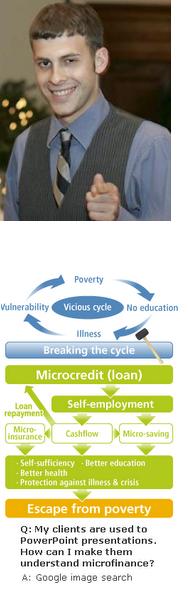
Jason and a flow chartJason Walcutt and I both attended, in a secularly religious way, the free vegetarian cooking class put on every week by the Hare Krishna club at NYU. The cooking class attracted a lot of lefties, and Jason, a business school student who always sat in the front row and wore a leather jacket, stood out.

Jason is a pretty funny kid. He talks, a lot, in a high pitched voice that sounds like he's warming up to sing. He speaks Mandarin. Allegedly, he was the brains behind the New Englander's Club, a group of 4 students that "discussed New England" once a month while NYU footed the bill at fancy restaurants like Le Cirque. So when a friend forwarded me an e-mail from him, telling tales of working in microfinance in Mexico, I had to find out more.

Microfinance (specifically here, microcredit or microloans) involves local organizations lending small but usable amounts of money to impoverished or struggling entrepreneurs. Money from loans is typically used to buy tools - a cow for plowing, materials for a family manufacturing operation - that can help make the borrower economically self-sufficient. Loan terms tend to be a few months, with interest rates pegged to local norms (which usually seem exorbitant at first glance; whether or not they actually are exorbitant is another matter).

So there's a bunch of issues that you can probably see coming - what is this good for, who decides, how do they decide, what are the specifics that determine which programs fail and succeed, are we feeding the poor from the hand of Adam Smith, capitalism is evil so where is the underside and how are these dickhead bankers making a profit off of this?

Jason (wearing his leather jacket over a Ho Chi Minh t-shirt) and I sat down to speak in Washington Square Park, where he told me about the differences between working in India and Mexico, why he thinks microfinance should be handled by banks and not non-profit NGOs, and about that time he stole a fridge from someone's house.

How'd you get into microfinance?

I was heading home from NYU and I remember I was heading home from graduation, and I thought I was going to hitchhike across the country and go work as a fisherman in Alaska, and then hitchhike down to Mexico, that was my big plan, and then a buddy gave me a call and said, "someone dropped out of this program I'm doing and they need someone else to work for an NGO in India, would you be interested?" so I just got lucky with it. And I didn't really have any other real plans so I said sure.

They asked me what I was interested in, I said entrepreneurship, helping people start businesses - that was sort of what I had studied in school - and I guess that paired up well with microfinance.

Real quick, how would you define microfinance?

Providing funding for people, entrepreneurs, on a very small scale, but who are all trying to do their own individual business activities, starting up small little shops.

OK. So you knew about microfinance before you went to India?

I actually didn't know about microfinance before I went over. There was definitely a Google search done after I found out about the job. It was right at the point where, I think, microfinance was starting to get a lot of press, in 2005.

I got set up with a fairly well established, mid-sized NGO, about 30,000 members - all women, set up in a self-help group system, where 5-10 women meet every week or so and they talk about their problems. And over time they establish a sense of trust and community, and then they start doing other activities, like saving money together, and once they build up enough savings, they can give out loans. So the NGO started out as a self-help group and sort of turned into a pretty substantial microfinance organization. We worked in the middle of India, in Maharashtra, which is about 10 hours east of Mumbai.

My specific role was starting up a separate program, a micro-health insurance program. What the NGO realized while they were doing this work in India, was that a few people defaulting, and they did research and found that the reason some people were defaulting was that they were taking the money they got from microfinance loans and using them for hospital bills. The government of India is supposed to provide free health care for people, but it doesn't actually work out that way -- you find that the system is very corrupt, the public health care systems provide very basic health care, if that, and that the doctors, if they're actually there, aren't that helpful. A lot of times people are forced to go private institutions, private doctors, that charge substantially more and it sort of creates a poverty gap.

Does that happen a lot, people using the loans for non-business purposes?

Well, the people always want to say, yes, this is for a business. In India, I was working for an NGO, which has a social/community aspect that a bank doesn’t have, so for these, the money was just going to people that needed loans. The alternative is that the people would go to a loan shark, who just don’t loan out money to the types of people we were dealing with, which are people that make about $2 a day, which put them just above the poverty line. If they went to a loan shark, they’d have to pay something like 100% interest, 120% interest.

What were you guys charging?

Around 60%. Those figures are per year though, and most loans are for a few months, so 60% interest is 5% per month.

What were you actually doing for the health care program?

For me it was really interesting, because I got to travel throughout India to study different kinds of health insurance programs that had already been started by NGOs. I got to go to Bangalore, where I saw a hospital sponsored program, and I went to another that had a partnership model, and another that had a community based program, which is the one we decided to go with, where all the funds actually come from within the community. The other two usually requires a larger financial backer in case things get out of hand.

How’d that work?

Everyone pays a premium, and that amount of money supports the health insurance that they pay out. I think we were charging about $1 per month for the insurance. So everyone pays the premium, and how health insurance works is that not everyone uses the health insurance every month. If your health insurance covers surgeries, you’re going to need a lot of cash on hand to cover the bills, but ours was a more simple program of primary care and checkups, where we worked out deals with doctors where we guaranteed them business every month in exchange for a reduced rate. So it made business sense for the doctors, but there was also an altruistic element to them being involved in the program.

And again, this is people just above the poverty line?

All the communities I was working with were already part of the microfinance network, so they weren’t the poorest of the poor. They had stable communities, where they had funds coming in, but, you know, no electricity in houses, no indoor plumbing, kids were running around naked – It was definitely the developing world.

What was your friend working on?

He was working in the microfinanced communities, working on the business structure after they people had already gotten loans and had some savings, trying to start businesses that can employ people in the community, so the money stays in the community and doesn’t escape out.

One thing he was working on was a home grocery delivery program, where, instead of having people go to the market every week, they would get a basket of groceries delivered every week. So the business charges a premium for the delivery service, but it also employs the local women, which gives them a job, more income in circling through the community. He also worked on outdoor toilet construction business.

One of the differences I would figure between programs run by NGOs and programs run by banks is that the programs run by NGOs would bring a value added component to their loans - education, technology, etc.

Right. A microfinance organization is just a few steps away from a bank, so the interesting thing about the NGO’s microfinance program was seeing how it shifted towards running more like a business. While I was there they had actually hired consultants to analyze them and figure out how to turn it into a business. That’s something you’re seeing a lot more of. Communities that utilize the NGO model can only take it so far; the NGO turns into a nice shell that you can turn into a business, that’s very workable, that already has roles assigned. A coordinator in the field gets made into a salesperson – where before they were going out into the field and teaching people about microfinance, now they’re going out into the field and selling loans.

So one of the good things about an NGO becoming a bank is that it can then employ more people from the community?

Yes.

So then, and this is just the first thing that popped into my head, it might seem like it’s just a cycle, that people learn about microfinance, educate more people about loans, then sell the loans, and then the bank becomes bigger and can employ more people - which means it can educate more and more people about loans, sell more loans, and employ even more people. Aside from just giving the people who actually work for the bank a job, is the bank benefiting the community in any way? Or it just kind of snowballing into a bigger and bigger entity?

One of the great things about it, and how I always viewed microfinance, is that it was sort of the capitalist way of social movement, social mobility, social enterprise. It goes to some of the lowest levels and says to the person, “If you work hard, you do your job and have a little bit of luck, whatever the venture it is you’re starting, maybe you have a scale and you weigh people and they give you a little bit of money, or a little handicrafts thing, if you do this and it sells, you’ll get more money coming in, and that money doesn’t go to a foreign bank, but goes back into the community.” Then with that money, you can either take out another larger loan or maybe it goes to your neighbor, who themselves start larger enterprises. And part of the reason why America’s been so successful is that we’ve had so much access to credit.

One of the biggest shocks I had when I went to China or Mexico, was how hard it was to get credit. It’s very hard to trust people. Here, you just pull out a credit card – I’ve got three in my pocket right now. But in other countries, it’s not that easy. And that’s why we’ve really grown so much; it’s so clean and it’s so nice. We have the access to capital and credit if we need it. So microfinance takes that idea and brings it to the lowest level.

When you hear that an NGO is becoming a bank, you think that it loses that social component, but actually it just…you’re not losing on the social component because the rules are the same, it’s just making sure that people abide by…if you don’t pay your loans, the community suffers. I do believe that an NGO gets to that point and doesn’t become a business is actually harming the community from further development. If someone takes out a loan and doesn’t repay it, and NGO might say “that’s OK”, but that hurts the NGO and it hurts the community, and that means that another person can’t get a loan now. So it’s important that you get stricter standards, and that’s what a business does, makes sure people pay. That whole social component comes into play much more strongly in Mexico.

OK, can you tell me about Mexico then?

I was in China and ended up in a meeting with the head of one of the first microfinance banks in China, seeing if I could get a job working there, and I didn’t, but I told him that I really wanted to learn and that I was willing to travel to wherever the next for profit microfinance program was going to start up, and that ended up being Mexico.

So that was a big change – Right away, you could tell that [the one in Mexico] was a business. In India, people would sort of wake up, go into work whenever they wanted, and if something didn’t happen that day, that was fine. That might have just been India, a cultural thing, a “whatever whatever” attitude at times; things get done in India, but time just seemed like it was never an issue over there. But in Mexico, they had an office, everyone in shirt and tie, loan officers in matching uniforms.

So the organization in Mexico was a for-profit company that had 5-6 branches spread across the state of Vera Cruz, which is on the Gulf of Mexico. I was there when the organization was about one year old. I guess one thing, the clients were very different. The poorest of the poor in Mexico are different than the poorest of the poor in India. The people we worked with in Mexico were lower middle class, just above poor – way above India. They had access to credit, and they were in a city.

The Mexican microfinance organization only gave loans to businesses, so you could only get money if you had been up and running for X amount of time. And that’s where I learned a lot about how they actually determine whether or not they can give a loan to someone, they had a very strict procedure. How it works: they have loan officers that would just walk around the city and go into businesses. In Mexico, you know, there’s a ton of small little mom and pop shops, selling tacos, shoes, groceries. So they go into the little shops and say, “Hi, my name is So and So, and I’m from this Microfinance Organization, and let me tell you about this loan.” It was door to door sales of loans. I always thought it was funny because I imagined if in the US, I just walked into a pizza place and was like, “Hi, my name’s Jason, I want to sell you a loan.” But that’s how you sell loans in Mexico.

So they meet with the people and take their information down, go back to the office and do a credit check on the business, then go back to the business and do an evaluation. The evaluation was 5 or 6 pages and was basically an accounting. Most of the places don’t keep records, they just go by, “OK I bought X number of tortillas this week and X amount of lettuce and by the end of the week I have this much left over so that means I have to buy this much more.” So we would go through and say, “How many tacos do you sell a week?” “50 tacos a day, so 350 tacos a week.” “How much do you sell each for?” “5 pesos.” So you’d get the revenue and do the same, “How much do you pay for each head of lettuce” etc etc. So then you can figure out their profits.

Then you’d list the assets they have – chairs, a refrigerator, a TV for people to watch. You’d also do their family’s assets, because a lot of people lived in the back of their stores. So, “OK, you have a car, you own your house.” So we’d get a financial profile of the family and their business, and then we’d run the numbers through some formulas, just like a bank here in the US decides whether or not you’ll be able to pay back one of their loans.

Then the loan officers go to the bank manager and the loan committee and everyone asks questions about each candidate, so other loan officers can ask you questions like, “Well how much cash do they have?” – so everyone can be very critical of each other. So the whole thing took some time. The company also has strict standards, like each officer has to get X amount of people each month to qualify for a bonus.

What were you doing? Did you know Spanish?

I was following the loan officers around. They didn’t pay me but they gave me housing. So I would walk around with the people, and you learn Spanish pretty fast when people are speaking it all day. In the beginning it was pretty tough, especially without knowing the lingo for cash, other slang. But by the end of my stay, I did one complete deal, where I found a person and said, “Hola! Me nombre es Jason. Soy un consultador.” And the person would say, “OK, I don’t know who you are, but sure, go ahead.” But the people who run the businesses are actually very smart; right away they’d say, “What’s the interest rate? Per year? Are there any secret fees?” They were actually pretty savvy.

In India, some of the people would be like, “Credit? What’s a loan? What’s insurance?” They had no idea what it was. But the Mexicans were pretty on top of it. So I went through the whole thing, talking to them about the business, going to the committee and presenting about it, and the people got the loan.

Did the loan officers get a commission on each loan?

It was sort of a weird structure. It was a bonus system. Each officer had a target, 5 new loans a week maybe, not including reloans where you’d renew people’s loans. Just to give you an idea, each loan would be around 3,000 pesos, which is about $300, and was for a term of 4-6 months, with an interest rate of 60% a year, so 5% a month.

What were most of the businesses using the money for?

Lots of things. It depended on what the business was. My favorite was the taco guy, because, well, the taco guy wants to take out a loan, that’s funny. People would want to get shelves for their store, or a new sign for their business, maybe a fridge. I think the largest loan I saw was for 20,000 pesos, $2,000, to a mechanic that wanted to buy some special piece of equipment.

How did the bank make sure the people were using the loans for their businesses?

You really can’t. After you give them the money, you just have to hope they pay it back. And that’s one of the major problems, so you run into, “What do you do when someone doesn’t pay you back?” You have to remember, when a person doesn’t pay, it’s really bad for the bank. That means that money they’re expecting to come in can’t go to someone else. Even when they’re a day late, it becomes an issue. And it became a pretty bad issue. I came right when the bank was having a lot of issues with people not paying back the loans. What happened was that the bank managers had just approved a lot of bad loans, people that already had loans or bad credit records and they gave out the loans anyway. I got there when a lot of turnover was happening.

That’s when I learned about the dark side of microfinance, which is what happens when people don’t pay. So there were times when I was on runs to steal people’s…well, not steal, but to take people’s refrigerators. You go into people’s houses and…if the people don’t pay, you can’t just say “No, it’s OK.” If this was an NGO, you might say that, but this is a business, so you have to get something to make the business run, otherwise the whole thing falls apart, and the people that are taking good loans out won’t be able to get loans anymore. I did a lot of banging on doors at nighttime, “Pay your loans back, we need the money now.” That stuff happens in the US too, so it’s not surprising that they use the same tactics in Mexico.

To effective ends?

Well it’s never good when someone doesn’t pay. What’s a bank gonna do with someone’s refrigerator? I guess they could auction it off, but a bank isn’t a seller of goods. It’s not really the desired outcome. But yes, they collected people’s goods and auctioned them off so they could make some money back.

What did you bring to the program in Mexico?

I brought them experience in microfinance, and no one was really fluent in English, so I did a lot of looking over documents, because a lot of the investors spoke English, and the bank was certified by the World Bank. I was there to learn but we both got something out of it. I wrote a few reports for them.

How did you leave the job in Mexico?

So after my 4 or 5 months in Mexico, I went to the CEO and said, “Put me somewhere I can do something.” I wanted to go to China but they had just opened one up in China, so they said, “What not try Sudan?”

They went from China to Sudan?

Yeah, yeah. Sudan would have been a program in Khartoum doing Islamic banking which is like regular banking but you have to obey certain Islamic laws. I wasn’t quite sure how it worked..

Like, you can’t charge interest, right?

Yeah, you can’t have usury and certain fees.

Is that an industry term? Usury?

No, no. That’s just…that’s what they [Islamic laws] say.

But a few things happened, like the US put sanctions on Sudan, and the embassy closed, and I realized a few things. The organization wouldn’t really support me, and I don’t speak Arabic, I’m not Sudanese. It would take me at least a year to get used to living there and then a year to actually do something impactful, so it was a very long commitment so I sort of backed out of it.

What would the setup have been like?

I would have been in Sudan, trying to setup the microfinance organization, with the help of another company called Damas, which is a Dubai-based jeweler. It would have been a full out bank.

You’ve done microfinance for a while -- have you become politicized about it, how it’s seen, etc.?

I think it’s still very new and it’s not going to go away, because it’s very effective. For organizations, for the individuals. It fills a niche and need. There’s a really great book by C.K. Prahalad called The Fortune at the Bottom of the Pyramid [subtitle: Eradicating Poverty Through Profits], a University of Chicago management professor. There’s billions of dollars amongst billions of people at the very bottom of the pyramid. And these people work really hard, and they don’t get the benefits. These people have the hardest jobs in the world, things like shoveling in the dirt for 14 hours days, and if they can devote that same energy to a business or entrepreneurial activity, then they’re going to do well. They know what hard work is and they’re willing to do it. There’s real potential to tapping into them and giving them a chance to start their own.

So the potential for microfinance, is it in eradicating poverty?

No, I don’t think that’s possible; we still have poverty in the US. It can definitely bring a lot of people’s standards of living up. I just think it’s a lot better than throwing money at people. You throw money at people, they don’t appreciate it and it gets wasted. But if you tell people, “You work for it,” people value that money and the work that they’ve done a lot more.

One thing I should say is that I think NGOs really do a lot of great work. I think that they’re the way that it starts out. They get in the community and start to understand it. I worked with banks in India that wanted to start up microfinance organizations and they just didn’t have any idea…Each community is like an organism and their problems are so unique to them. So where a bank would try a one-fit model, an NGO would know the right way to market it and interact with the people the right way.

So, maybe, the places you went would aspire to be served by banks, not NGOs?

Yeah, absolutely. If all these communities had a local bank…If my parents can go into a Chase, they know the people that work at the bank and they know they can get a loan from them because they know that these people are trustworthy. In a lot of these areas, a very poor person will go into a big city bank and won’t get a few words out of their mouth before they’re asked to leave. In a community bank, the bank manager knows your situation and your individual business; I worked in Mexico with this branch manager who said, “I know this guy, I know his business, he always pays back.” And that’s a good feeling, when people that can trust the Bank and the Bank can trust people.

When a bank gives a loan to a community business in a developing community, the intention is that the business will make more money, pay off the loan and be able to take more money home. Where does that money come from? Inside the community, outside?

It depends on the community, but say in India they harvest sugarcane and travel to another village to get groceries and healthcare. So if someone starts a business that sells eggs, the people don’t have to go outside the village to get eggs, and the money circulates back into the community. Someone is getting less business, yes. But, say, that someone that is getting less business is a corrupt doctor that is charging exorbitant amounts for services that should cost a fraction of what he’s charging, then I hope he does get less business. That’s something I saw firsthand. I’d go into hospitals and just see doctors abusing their rights as doctors, charging ten times as much as they should be for a simple procedure, simply because there’s no other alternative. If he loses, I’m fine with him losing.

Does that happen? So it’s like a capitalist justice and the free market is the sheriff?

Yeah, it’s called social capitalism.

You saw that in action?

It was one of my eye opening moments. I would talk to people who would talk about a doctor that was overcharging, then a new doctor would come in with more reasonable prices and say, “No, what’s fair is fair and what he’s doing isn’t fair, and I’m going to be fair,” and as a result he gets lots of new business.

So is that another example, that the more doctors or businessman there are, the more they will compete and the cheaper services and goods will be?

Well, it depends on the product, but the hope is that the people who do good work will do well and the people that do bad work will do worse. Inequalities in these systems are present all the time and we hope that microfinance will help balance it out and give the people a little bit of leverage. Cash in pocket gives a person a bit more bargaining power. If you’re at the doctor’s table and he tries to charge you 10 times what he should, and you have cash in pocket, you can say to him, “Well then I’m going to go to the other doctor,” and the doctor in front of you might lower his prices. So yeah, it’s capitalism.

When you read about microfinance you often see it framed in a certain way, like the guy that won the Nobel Prize, that it can lift countries out of poverty. Are you saying that’s not really how you think about it?

The only way the industry’s going to survive is if it becomes more business-like and it takes a real business approach. You can’t let people off the hook when they don’t pay, and that causes problems for everyone in the community. Microfinance gives people a real good alternative to what they have, but there’s a point when the NGO needs to say it itself, “For our survival, for the community’s survival and growth, we need to put more standards in.” And that’s where the industry is trying to figure out what its next path is, what’s going to work in the future. I’ve seen dialogs with people from Africa and Russia and China and they mix their ideas together, this has worked here and not here, so it’s a real global test; everyone’s trying to figure out what’s the best thing and I think in a few years you will see some very clear cut models for how to do business in these countries.


The New Yorker wrote a nice article about microfinance, beginning with a few pages about Muhammad Yunus, who started the Grameen Bank in Bangladesh and won the Nobel Prize in 2006. The article is here.


Saturday, September 22, 2007

penny neff, recovering ngo'er

About a month ago I saw Penny Neff on gchat and we had the following conversation:

me: hi! are you lost?
penny: haha, why?
me: i've never seen you here! [on gchat] also, i forget where you are
penny: well, now i'm back in jersey, at my mom's house. i was in nigeria, working on a short-term project for an NGO, but i was in a car accident so now i'm back home recovering
me: oh no. what happened?
penny: i was in a head on collision and broke my back

I had to google "broken back" just to stay in the conversation.

Last I had heard, Penny was teaching at an environmental school in the Bahamas, with an unbroken back, so I was surprised by about 100% of that conversation. I had met
Penny in biology class during our senior year at NYU, and after I convinced her to start coming to Earth Matters! meetings we became pretty friendly. As someone perpetually considering moving to Africa and doing NGOish work myself, her situation and story resonated with me quite a bit. And thus, about a week after visiting Penny at her mom's house in Teaneck, NJ, I asked Penny if she'd tell me about the accident.

So you were in Nigeria.
That's a good place to start. I went with an NGO, OIC International, based out of Philly and I got there around July 15th. I was a "medicinal plant specialist" - I had studied bush medicine in the Bahamas. The "specialist" part actually made for some awkwardly hilarious moments when people thought I could tell them all about their plants in Africa, and I had to explain that expert was a bit of a stretch. I got introduced as a plant doctor at a village's micro business training and everyone went crazy.

What were you supposed to be doing there?
My project was to be three weeks long, but the actual project changed several times, Originally I thought I was going to be working with a women's co-op that wanted to grow medicinal plants for sale, and I was to assess who they could sell them to, what plants would be most interesting to outsiders, etc.

But then I found out I was supposed to work with a school in the same town, planning a botanic garden. However, the morning I was supposed to start - I had met with my host family and everything - we got a call that they had been robbed the night before and my project manager didn't think it would be safe for me to go there. You also have to understand, I was going to be in a village with no electricity or phones, where even cell phones didn't work, so if something went wrong I would have no way of doing anything about it. We visited the village and it was beautiful, but more middle of nowhere than I'd ever seen before.

Did all of that make you nervous?

Not really. The weird thing is that for some reason I had a feeling something would go wrong from the beginning. Maybe just because the NGO seemed disorganized, but when I told people I would see them later, I thought in the back of my head "as long as everything works out". But I wasn't necessarily nervous, just prepared for something to go wrong.

How were your first few days?
Well, the first 2 days were totally disorganized because I didn't know what I'd be doing or where I'd be doing it. I was eventually reassigned to a village called Alok, and I moved into a hotel room in Ikom, a bigger "city".

Alok has these amazing stone monoliths carved 2-3 thousand years ago, and the Cross-River State Tourism Bureau, among others, is working on an outdoor museum. In the south eastern part of Nigeria, near Cameroon. I was going to be working with an American girl, April, interviewing the local oral historian about medicinal plants near the monoliths, to collect information for tourism literature and signs for the museum as well as perhaps plans for villagers to market medicines to tourists.

The third day, I was in the forest villages, seeing drill monkeys,which were assumed to be extinct and are now being captive-bred for reintroduction into the wild. Then we got a late start back to the hotel - that was when I got introduced as a medicine doctor and there was a lot of hubbub. Seven of us were piled into a pickup truck: me, April, Kennedy (an OIC director), Patricia (another volunteer like me), two other volunteers and our driver Charles. Charles, April and I were in front, buckled up, and everyone else in the back wasn't wearing a seat belt, as far as I know. Also, it was dark outside, and because it's the rainy seasons there now, it was raining.

Right before the accident, I remember thinking that we were going too fast and I wanted to say something to Charles, but safety is really different down there and I’m sure he wanted to get home. I would say we were going about 40 mph, maybe faster. As we're going around a bend, a car coming at us starts swerving. At first I thought they were OK, just took the curve a bit too quickly, but then they were coming right at us. For a while afterwards I kept seeing the car coming at us and the cracked windshield with light shining through. I remember thinking right before we collided, "oh shit, this is going to be bad. There are no hospitals anywhere." It happened very quickly and I don’t think either car tried to slow down before the collision.

The other car was in your lane?
I think so. I couldn't see any of it after the fact because I couldn't move. The police determined that it was the other car's fault, whatever good that does.

I remember opening my eyes after the impact, and I had hit my head on the dashboard and immediately became conscious of terrible pain in my lower back and abdomen. I felt as if my torso was being strangled by the seat belt. I opened the door and tried to take off my seat belt to stop the pain, but I remember that the back of my seat had collapsed and it was difficult to get to the seat belt release. April was sitting next to me and tried to help me out of the seat belt, but I got tangled and fell out the car door. Then I just laid on the side of the road next to the car, not knowing what to do. The whole time it was pouring rain. April was freaking out because she had hit her head and was covered in blood.

What was your first thought?
Immediately I was thinking, shit, back injuries are BAD. After the accident, I was carried out of the rain to a shelter off the road (I believe by people in the village where the accident occurred) and I was then put in the back seat of a car to be driven to a hospital in Ikom. My back felt like it was collapsing and of course no one knew how to carry someone with a spinal injury and I must have sounded like a nut, screaming instructions to everyone. I'm not sure anyone could understand what I was saying, which was mostly just, "Support my lower back!" Also I was freezing and I really wanted someones coat. I was shaking uncontrollably, but mostly I wasn't able to talk much at the time. The pain was so intense, I have never felt anything like that before and I didn't feel like I could make sense or think properly or anything.

How were the other people in your car?
Patricia, one of the other volunteers, was injured pretty seriously and got put in another car and taken to a different hospital The others were scraped and bruised and in a ton of pain, but up and moving around.

Then you went to the hospital?
The hospital was in Ikom, which was about an hour from the accident. The doctor at the hospital wasn't there right away, so I laid in bed by myself for a while. At some point the doctor came back and I got an IV and was given some pain killers, but the doctor didn't do much else, not even look at my back or take my pulse or blood pressure. I ended up checking my own pulse because I was freaked out no one else did it, and it didn't sound too fast so I decided I'd probably be OK. I was in the women's ward, with at least 5-10 other women that moaned and coughed all through the night.

At 6 in the morning a preacher came in to get everyone up with some inspirational talks about God. And, of course, the doctor left for the night with no instructions to give me more pain medicine, so I woke up around 1-2am in terrible pain. I felt like such a pathetic American, wanting medicine while everyone else suffered. The people generally spoke English, but that doesn't mean it's easy to understand for an American...the accent was totally nuts for me. And beyond the language, our expectations are so different in a hospital that I felt like often I couldn't communicate with people.

Did you talk to the other patients at all?
No, I couldn't move and no one was right next to me. The next day some of them came up to me to say they were sorry. (That's what everyone who visited me did: apologize. I still can't figure out what it meant, exactly) I spent most of the night just writhing and calling for the nurse.

What was your mental state like?
Shit shit shit shit. There's nothing to focus on but the pain. in some ways it was a very stable mindset. It makes me understand why people with chronic pain sort of lose themselves. This might sound all dark and creepy, but I really thought that if it continued hurting this much there was no use in living. Which is way too dramatic since I wasn't dying, but I just didn't know how to handle it. And at the time, I was terrified of having internal bleeding, since I knew I wouldn't get help in time for that, It's hard to explain how difficult it is to know what's going on when all you can look at is the ceiling or sky.

Were you in touch with the other people from your car?
Kennedy was with me. April came to visit the next morning, I think - it's all sort of fuzzy. I was told that Patricia, the other American volunteer, was at a different hospital but that she was OK. I think everyone but Patricia visited me the next day.

Kennedy told me that they were arranging for an ambulance to take us all to a better hospital in Calabar the next morning, but we didn't leave until after 4pm, so we had to drive at night again, which totally freaked me out. The goal in Calabar was to get x-rays and hopefully more consistent pain relief

Were you thinking to yourself, I'm keeping it together pretty well, or that you were going crazy, or were you not even thinking about kind of stuff?
I wasn't thinking about it at all, really. When I was on painkillers I tried to keep it together, especially since everyone I'd ever met in the area visited me that first day in the hospital and I wanted to be grateful and not a raving lunatic. But it was driving me crazy that everyone kept saying they were sorry, or that I would be fine, or that God was watching over me, but no one except April would just talk about it like it was. That's the American thing. I just wanted to talk about the reality of what I could be facing. Same with her, since she had a pretty fucked up forehead, lots of glass and all

How was the new hospital?
I was just wishing wishing wishing that I'll be greeted by EMTs who know how to carry people and work a stretcher (no one knew that the stretcher in the ambulance could come out and roll, I think it was the first time the ambulance was used). So we get to the hospital and there is a nurse and doctor but no one who knew how to work a stretcher and I had to explain about taking it out of the ambulance, and then of course the clinic was not set up to accommodate things like that--all stairs and small hallways and tight turns.

Overall the new hospital was much nicer, but they still didn't give me consistent pain medication, so I was a roller coaster of pain and then sanity and then pain again. There was actually a really interesting article in the NY Times about this, the lack of pain medication in developing countries.

I got an x-ray the next day, 3 days after the accident by now. First day I had a full meal, too, but I couldn't really eat because everything hurt so much. The x-rays showed that I had several fractures in the lowest vertebrae, L4 and L5. The orthopedist said they were potentially unstable, as in, possibly going to cause or already caused nerve damage. I was fitted with a traveling fiberglass torso cast and from then on was treated as a spinally injured patient, which means special ways to turn me on my side and move me, etc.

Did the doctors have a prognosis for you, aside from maybe nerve damage?
They just wanted to get me to a better hospital where I could get an MRI, so this whole time my air evacuation was trying to be sorted out. The NGO fucked up and their insurance wouldn't cover it, but luckily I still had my global insurance from my work in the Bahamas. So it was decided I was going to be flown to Paris.

Can you explain the insurance issue?
The insurance was a complete mess the whole time I was there. Essentially, they found out after all this that their insurance only covered local evacuations. Another woman, Patricia, was also in bad shape and it was going to cost $90,000 to get us both to a better hospital in Europe or the US. They didn't find anything in her x-rays, but it ended up that she had I think 3 pelvis fractures that are hard to see in x-rays but easy with CT scans. So she ended up being flown home on a normal flight, in coach, and it was terrible.

When they found out about their insurance - they told you as a sort of "well, this happened but we will take care of it", or as in "well this happened and we don't know what to do now?"
"We'll take care of it," but it didn't seem like anyone really knew what to do and I was pretty nervous. They couldn't pay for it without approval from the board--anything over $30,000 needed approval. I also didn't have a cell phone so I could only hear about things from the American side when I talked to my dad once a day. There's a whole inquiry thing going on right now, and they changed their insurance right away. So finally it became clear that the fastest thing was to get me out with my personal insurance, not their travel insurance. The whole insurance thing was stressful...the hopelessness of the situation felt terrible, I felt like I was never going to know what was wrong with me and get help.

Anyway, I was picked up 6 days after the accident by a little jet to fly to Paris.

How was the Paris hospital?
Paris was a bit less eventful, just good health care. I was very excited when the nutritionist came to see what I wanted to eat and said that there were 22 varieties of cheese. They said I had no neurological damage, although apparently I was close.

What did they say about your recovery?
Well, that I'd have to be in my super crazy corset for 3 months, that I'd probably be fine but was at risk for arthritis and back pain my whole life. But that I would be able to have children, be normal, etc.

How long were you there?
About 10 days in Paris. At some point we should talk about the other people, really.

OK. The people from the other car?
Yeah. There were 8 people in the other car, which was a sort of taxi, taking a bunch of people who were all going towards the same place.

Only 2 survived, a mother and her son. I don't know much more than that. The woman got out of the hospital rather recently; she was apparently at the same hospital as me, but in a different room so I never saw her. I haven't quite figured out how to handle the fact that other people died, and it was probably mainly because we were in a truck and they were in a small car. April saw them and said that it didn't look bloody, but I think 2 or 3 people were dead on impact. I was sent pictures of the cars after the accident, and the little car essentially has no engine left, the entire front is gone. I’m not sure how they even got people out of the car.

Were they all Nigerian?
Yeah, from different villages I think. I’m hoping to send my leftover money back to the woman who survived. You know, we never knew much about the other people, since no one knew them, they were just passing through. I know that one of them was traveling with 90,000 naira (about maybe $700 or something) and the villagers collected everyone's belongings and returned it to the deceased's families and the villagers apparently took care of the woman's child until she was conscious.

It was a classic clash of privilege, you know? We were in a new Hilux truck, some of us wearing seat belts, expecting good health care and then the other car was so small and I doubt anyone was wearing seat belts if there were 8 of them in it, and they essentially had no chance. The woman who survived stayed in that first hospital, I think. I’m not sure what they were able to do for her, really.

I mean, there were chickens running under my bed in the morning. It just wasn't what a Westerner would accept in terms of health care. I felt totally conflicted because I wanted my nice safe health care, even though I knew it was unavailable to so many people and that I was coming from such a privileged place.

Health care or any sort of social capital in developing countries is at such a premium. "Brain drain" - probably about half of all Nigerian doctors leave the country as soon as they can.
I know. Apparently at Patricia's hospital, at the very beginning, the doctor was great, probably trained in Europe, but had no supplies to work with. And my orthopedist was wonderful, but he couldn't do anything but send me elsewhere. The nurses all said to me, well, now childbirth won't be hard for you at all

Do you see any connection, irony or...fittingness or god damn-ness about going there to study a sort of indigenous very natural kind of medicine, and then the aftermath?
Haha, yes, it was fairly fitting. I really respect just basic medical care and think that we Westerners are very lucky in some ways, but we have come to assume that our health care is normal and death and pain are not, and its just not like that in other places. And hey, morphine is from opium. Yay plants.

Now you've been home for month, month and a half? How has it been?
Yeah, probably 6 weeks I think I was a lot better off before I came home in someways, because I was just focused on survival and not; really emotional and not thinking about the future, except for one conversation with my physical therapist about what my life could be like. Then...I'm living in my mom's living room. unable to walk, really. can't shower, can't eat sitting up, and I’m like, shit. I’m a cripple. This is terrible. Of course, I got better quickly, but there's something OK about being unable to take care of yourself when you're in a hospital with nurses who are paid to do it. It's very different when you're back in your mom's house at 24.

When you got to Paris, did they take off the Nigerian fiberglass cast?
Yeah, and fitted me with the fabulous corset that you witnessed. I wanted to take my Nigerian cast with me because everyone had signed it, but it was too big. My new French corset was hard plastic and went from up by my collar bone down to my lower back/butt. It was black with straps and a hole for my breasts, which made me feel like a mix between Batgirl and a 19th century porn star.

I've now got a 3rd brace, that's a bit lighter weight and made from cloth and foam. The 3rd one makes me feel very medical. It's white with a lot of strings and metal clasps and velcro - but it breathes more.

What have the doctors been saying lately?
It seems like I'm healing super fast - I thought I was going to have to be in the French corset for much longer, about 3 months, and he said I should move on to the new back brace after only 2 months. I saw the latest x-ray and my main bad fracture just looked so much nicer and smaller. I should be able to start physical therapy in a few weeks, which to me is really when I start to begin that next step in the healing process. Even though I can lead a more "normal" life now, I am still reminded often that I am weak and my body is not responding to things as it used to. I think most of that is now muscle weakness, and I can't wait to be able to stretch and exercise and restrengthen my back. It's very funny, I used to hate exercising and now the thought of it is really comforting.

If OIC offered you another job in Nigeria, would you go back?
Oh, that's a really great question. I think there's two parts to that: was the work I was going to do really that useful? And, am I too scared to go back?

For the first part: Because of the accident, I've been focusing on the medical system in Nigeria, its lack of resources, etc. However, we did not talk about the actual usefulness of the work I was to do in Nigeria, or in general the benefit of US development aid as it is now. I'm not sure how much development work needs to be done by Americans traveling to Africa, instead of by the affected people themselves. Which would be more positive locally, as well as save money that could instead go to local people--I mean, several thousand dollars was spent to send me to Nigeria. Our funding required my airline tickets to be on an American airline, but was that the best option? I don't know too much about it, but it seems that a lot of US money goes to helping Americans, who in turn "help" Africa--a good example is selling cheap US commodities to NGOs in Africa, who then sell the US commodities at low prices to make money for the organizations. All this at the expense of and instead of buying from African farmers or African manufacturers. I'll plug another good NYTimes article.

The NGO I was working for is not involved in anything like that, as far as I know, but I do think that sometimes our aid is not really as useful as we think or hope it is. My experience in this area is extremely limited, but I want to learn more about it. I'm also not sure what other possibilities are out there--it seems like funding requirements can really limit options. At the same time, it was such an amazing and exciting opportunity for me, personally, that it's hard not to be grateful and hope for that sort of thing to pop up again.

As for the second part: when I was in Nigeria in my various hospitals, everyone kept asking me if I would come back and saying they hoped I would. I mean, the freaking governor visited me in the clinic. This was clearly partly a tourism/funding thing, as well as I'm sure genuine concern that I wouldn't come back to their country. And I would think, hell no, I just want to get home where there are traffic laws and emergency rooms. Then, once I got back, I wondered about my project and how it was going and how much I personally regretted not being able to really talk to the local oral historian and medicine expert, and I felt like if I could, I would want to go back and finish my project, although I think by the time I can travel comfortably my role may already be over (or I may need to make some real money). Now, I feel like in some ways I was intimately involved in how things go in Nigeria and really experienced what it is like to leave your expectations back where you come from (even though I was treated to the best there was). I met so many great people while I was there and so quickly understood how cultural and historical and economic differences affect everything and I feel sort of humbled.


Thursday, September 13, 2007

emily nemens, kerouac resident

In the November 24, 2005 issue of Time Out New York, an article entitled "Feast for the eyes" talked about new art installations in the city. Seven artists were mentioned, including Picasso, Warhol, Rauschenberg, Matthew Barney and Emily Nemens.

Emily was a friend of a friend that started coming to our weekly soccer games in McCarren Park about a year ago. We became fast friends and I soon became privy to tales of her art shows, concerts and book readings. Over the summer I read about half of a draft of Blue Eyed Apples, her novel about two 20-somethings, and her graphic novel, A Long Walk Home, about the bombings in Madrid. Four months later she sent out a mass e-mail saying that she would be living in Florida for three months, the latest recipient of The Kerouac Residency. She will live rent-free in the Orlando home of Jack Kerouac where he wrote parts of The Dharma Bums.

I spoke to Emily last Thursday night, a week into her stay, about some pretty lofty things - the 50th Anniversary of On the Road, living and writing in Orlando, and whether or not she is a polymath.

How long have you been in Orlando?
I arrived last Wednesday, so 5 or 6 days.

What is the house like?
I would call it bungalow-esque. It's from the 50s, if not earlier. It was a duplex when Jack Kerouac lived here. You enter in the front and there's a kitchen and a bathroom and a bedroom, which is where I am sleeping. Then in the back there's a separate entrance where there is a big workroom and a small bathroom and a small bedroom, which is where Jack and his mom lived.

How did you hear about the program?
I was looking for a residency through NYFA, the New York Foundation for the Arts, which has a really big searchable database of resources.

What did you use as a writing sample?
I used the first chapter of my novel, which has yet to be published.

Is it going to be published?
I'm workin on it. Will you publish it?

Were you a big fan of Jack Kerouac?
I like him. I hadn't read anything more than On the Road, in all honesty, but I liked that book a whole lot. I have since read The Dharma Bums, since he wrote that when living here. But I like On the Road more.

What about On the Road do you like?
When I first read On the Road, it opened my eyes to so much: this youth culture, this American landscape, this remarkable style of literature. Now I see it more as a cultural icon and reference point; I've seen a lot of those places, know a lot of people like that, read other things that pushed literature in new directions. But this one book did so much of that for millions of people, really opened America's eyes, helped the country come of age.

What if it were The Dean Koontz Project or the Dan Brown Project, would you have applied?
Yeah, I would have. Actually, Bob Seger also used to live here, so I guess there was a big debate about whether or not there'd be the Jack Kerouac House or the Bob Seger House. But mostly I was looking for a way to get out of New York City and write for a while.

What do you think of Orlando? Is it a good place to live if you want to stay in and concentrate on writing?
It's a good town to concentrate on writing in. I've gone out once, on Friday, with a kid I travelled with once. It was a little like an overgrown frat party. - none of us were in love with it, but it's also the place where people go, begrudgingly. It's also a very car-centric city, and I don't have a car. 5 blocks is a long way to walk here. So it's a good place to buckle down. I've been here less than a week and I'm still working out the schedule. I've been getting up at 7 or 7:30 - I like writing in the morning. In Brooklyn I'd get up at 5:30 or 6 and write for 3 hours before work if I had a good idea. I'm trying to cope with the mid-afternoon doldrums, when you've been working but the day's not over yet - either I'll settle down or I'll buy myself a small trampoline.


What are you working on?
Right now I'm trying to get some illustrations out the door. I'm collaborating with Harvey Pekar - which is wild and crazy. A professor of mine edits a lot of graphic novel anthologies and Harvey Pekar was looking for someone to illustrate a script for an anthology of a bunch of stuff by Studs Terkel.

You're Ryan Hagen's wet dream right now.
Hi Ryan! Yeah, it is random and fun. The drawing style isn't exactly my scene or come particularly naturally to me, but with due diligence, it'll look the way comic books are supposed to look. I did the drawings in New York but there's a million hours of Photoshop work at the end, retouching the scans.

So in addition to the Pekar stuff, I also want to write some short stories.

What's the expectation for you down there? Do they know you're going to be painting?
I don't know that they know about the art stuff, but I don't see why it would bother them. Especially if I'm like, "it's a graphic novel...." But it really is a very open residency. I came in saying to them, "I wrote this book and I really want to write more but I can't think hard enough in New York." I have to give a reading at the end, that's my only obligation.

What's it going to be like?
I think it's going to be wine and cheese-y, with a lot of people from the community, but I'm not sure. The last woman that was here kind of took Orlando by storm; she just sold her book and is starting the Columbia MFA program now, so she had her shit together in a way I can only aspire to. Using her as a model of what the residency is like would be problematic for me. But then again, I could.

What are your short stories going to be about?
I have an idea that they will have the same cast of characters as my novel and tie into the novel in some way. Instead of saying, "I will compose a novel," I like working in a way where things come back
around.

Novel is done?
Maybe near the end of the residency I'll pick it back up but for now I'm really happy with it. So I just need to convince someone with a press of the same.

Do you want to give a short synopsis of it?
Sure. It's called Blue-Eyed Apples, and it's a coming-of-age story that is set about five or seven years ago. It's about a boy and a girl who grow up together and move across the country and learn how to make buildings and make movies side by side.

Have you been focused on the story between the two characters, or is there a big preoccupation with the style?
Well I had this idea, and, well I still think it's a good idea, but it's put me into an experimental realm of fiction that's harder to get out there, but the idea that the novel is written as a film. As a painter I really like to talk about art and visual things, so I wanted the narrative to be very visual. So it almost reads like a movie.

Has that changed in the past months? The draft I read had parts written as a screenplay.
I took out most of the screenplay elements. That's a physical...that's a movie written down, and it's not quite the same effect for the reader. So now it's just written in a very fast paced and intense style.

You have a piece of writing on the Kerouac Project website. What's that?
That is adapted from a chapter in the novel. I had this idea of the American road and seeing the country, experiencing that as a young man. It's two friends driving to every baseball stadium in the country, one or two a day, over the course of a month in the summer. I really like baseball. They asked for something and it something that is obviously...Kerouac-ian.

Is that what the Kerouac people expect from you? What if you wrote, say, a meditative love letter to isolationist stock brokers? Would they ask you for rent?
Well no, they're a pretty laid back crew down here.

You're talking about travel with regard to writing now, and from what I know of you personally, you talk about travel fairly often. But what you're writing about isn't an undiscovered little cave in Andora with giant green frogs - or the converse, critiquing that kind of thing. You're talking about the flyover zones and stuff that's in front of us. David Foster Wallace wrote a little thing once about how he thinks domestic or familiar travel is endlessly better than foreign travel that is an imposition on places that would be unequivocally better and realer without tourists.
Something that always comes back to me is nostalgia. Collective nostalgia and personal nostalgia. My mom is from Nebraska and I've been there, but once my grandmother passed away, I didn't know when I was going to go back to Omaha.

On your website you can see the links to your articles from the Brown newspaper, bits of your fiction, your graphic novel, paintings of yours, mentions of your saxophone gigs. Why so many things?
I think because I have to. I wish I didn't; I wonder sometimes if it's lack of principle, and if I want to be a writer, why did I bring my saxophone to Florida?, but I like learning how to express myself in different ways and I like putting myself in hard situations in that way. I would have been fine being an English major in college, but I decided that I wanted to learn how to paint, and painting with oils is one of the hardest things I've ever done. So I could have stopped at any point, in learning these different mediums, but I chose not to. I don't know, we're still young so maybe something will get ousted in the next few years, but I hope not.

Do you think of yourself as a polymath?
Oh, I don't think I've mastered any of those things. I've been fortunate that some things come pretty easy to me, but I also take that to mean I work very hard. The fact that I learned how to play the baritone saxophone doesn't mean that I think a lot of myself for it. I want to learn it better. I think it's just more that I like knowing about the different things out there and having a cache of experiences through them.

The traditional graphic novel form doesn't really do it for me. But the idea of putting words and images together is great. I'd love to find a way to put them together that is more synergistic with my practice.

When you work in all these different mediums, are you dealing with similar issues, or is it, "I generally paint when I am sad, write when I am inspired" type of thing?
Like I said, I really think nostalgia. I keep coming back to being an observer of person. There's a lot of different ways to observe. I'm not a science-fiction writer. I really am trying to capture the human emotions and the beauty in the world around us in my writing. And with painting as well. A lot of times those are fleeting things, that are gone, but I want to find them. My favorite thing to do is to get my saxophone and play a jazz ballad, one of those really old-timey Duke Ellington kind of things. I know there's a lot more music out there and I should be playing different things, but that's what I like to do. I wish I could write adventure stories or play be-bop better, but I'm drawn to the sort of beauty of either sadness or nostalgia or memories.

Sadness, but when you say nostalgia, you're trying to get at it in a positive sense, more like Our Town than Winesburg, Ohio?
Because I'm an optimistic person, but, well, my graphic novel wasn't particularly optimistic. It was me walking around literally for a year with these images in my head and not knowing how to cope with them; I'd been in this foreign country during this bombing and I didn't know what to do, and it took literally drawing pane for pane all of that confusion and all of those horrible images, it took going through all of that again, and I came up with a coherent work out of that.

In that case, you experienced it and a graphic novel was what came from it.

Yes. I think even my fiction is an extension of that, taking people or places I've been and re-imagining them. If I meet someone at a coffee shop, what happens when they go home? Or someone tells me a story about their mother and I'll think about that mother six months from now, what it was like for her to grow up. It feels very weird to be our age and be stuck in the past, to be so enamored with old-timey music and wear vintage dresses and to prefer making hand-made books instead of websites. But then again, I'm stuck there.

Stuck there as in, your job was doing graphic design and making websites for people.
Yes. But with my art, I feel like painting is on its way out. Of course there's digital stuff now and it feels very antiquated to commit yourself, but also necessary, and I'm interested in taking old images, paintings or found photography, and giving them a second life with an outdated medium. So even my painting has something to do with nostalgia and things past.

Do you find that because you're doing writing and music and painting, and living in New York, that it's hard to concentrate on any one, or even to read a lot of books or listen to new things?

Yeah, it is. It's really good to be down here. There were times [in New York] when I found myself only listening to Swedish power-pop for a few weeks, just because I forgot to try something new. There are weeks when I only read The New Yorker. And that doesn't make me happy, I don't like that. It's amazing that since I've been down here I get up, I write, I write some more, I read some, I work on this Harvey Pekar thing, and then it's 11pm. It's amazing anyone functions in New York I guess.


Emily Nemens is 24 and will return to Brooklyn in December.
Some of her work is available at her website.
If you own a printing press, she will gladly send you her novel.


Tuesday, September 11, 2007

chris stanislowski, patient


loyal ilovepostage readers will recall a previous interview done with chris stanislowski, a great friend that moved to argentina last fall. he is still living in buenos aires, where he teaches english, is becoming fluent in spanish, and is gettin knee deep in the mud and scrappin with the best of them. unfortunately for chris, this scrappin' led to an accident on september 10, an accident he described to me on gchat later that night.

chris is no stranger to medical tribulations. while in wisconsin last christmas break, chris told his eye doctor that he was having some problems with his vision. a week later he was undergoing emergency surgery to repair a detached retina in his right eye. while his detached retina might have been diagnosed by high tech tools, a decent way to fix the problem wasn't on our radar just yet. so chris spent the next three weeks lying on his stomach in a massage chair, face through the occipital hole, waiting for a gas bubble to center itself on the retinal aperture until the retina was sucked back into place and reattached itself.

you would think that toughness gleaned from this experience, reasonable apprehension about borderline Second World healthcare and a modicum of pride would have kept chris out of the hospital after a tvp (textured vegetable protein) experience gone awry but, what can i say, the man is always full of surprises and i have deemed his pain to be sufficiently quirky to warrant an interview.


vlcsnap-1265697


wow, so what happened?
I was trying to separate two frozen veggie burgers with a butcher knife. well, they separated. and in the chaos that ensued a portion of my ring finger on my left hand separated too.

wow. what kind of veggie burgers?
there's only two kinds here - normal and "sin sal". the latter are gross

i mean, what brand were they? do they have just one brand or do you have options?
vegetelex or something

bananaphone...
yeah, it sounds more like a communications company

were you just planning on eating one of them?
yes. i wasn't greedy

what would you say, you nicked yourself with the knife? sliced open your finger?
I sliced open the middle part of the finger horizontally

eee. i'm sorry. is it shorter now?
I blame myself. and vegetelex. no, i didn't cut it off. just bled for a while in the apartment. after i got back from the hospital i ordered food from next door cuz i was gonna be damned before i tried to cook again and the crazy old guy who owns the restaurant asked cameron if she cut me for "behaving badly"

research has shown that gay men are more likely to have a shorter index finger. were you trying to hide something?
by cutting my ring finger?

(so they'd be the same size) also, that's an old wives tale and then i just made up the research part, but i googled it and here's an article:
that doesn't make any sense but thanks for impugning my heterosexuality again

it does too make sense. if you have a short index finger, you have a longer ring finger, so if you cut your ring finger it's less obvious.
ok.
your logic games baffle me.

who do you place the blame on for the incident?

my roommate manu. he just sharpened the butcher knife last night

In Hinduism, Manu is a title accorded the progenitor of humankind
groovy

Mahabharata says: "And Manu was endued with great wisdom and devoted to virtue. Manu had fifty other sons on Earth. But we heard that they all perished, quarrelling with one another.
and trying to wedge butcher knives between shit

so you're bleeding. you immediately go the hospital? how do you get there? where is it, etc
well i realized quickly toilet paper wouldn't be a sufficient means to stop the bleeding. so i went to find an old article of clothes to wrap around it

at this point i should interject and remind readers that you use t-shirts for pillow cases
i chose a ripped pair of brown plaid boxers. i first picked up a pair of yellow smiley face boxers

which is actually kind of a good idea, but if you don't know it's coming, it looks very alarming
but I imagined myself in an emergency room with that wrapped around my finger and decided no. I already felt stupid enough for having cut my finger like that as it was

argentinians are fickle. so how'd you get to the hospital? was cam home and did she go with you?
she was working near by she met me and we took a cab

what was your phone conversation like?
I was trying to play it down. I was like "Hey honey, can you do me a favor. Can you take me to the hospital?"

ooooooh "honey". what happened when you got to the hospital?
i have my underwear wrapped around my hand and the guy at the entrance asks me to show him my finger to make sure its the real deal. which was my biggest fear at that point, that i would have made my girlfriend take me to the hospital and have them tell me i just needed a bandaid. but i passed
the test
and got to go to the traumatologia section

what's their triage like? the guy at the door just pointed you to trauma?
first i got registered, then i went there. it didn't seem like there were any real emergencies there. i saw one girl limp a little when they called her. i think i had the best injury of the lot of them

what was the wait time like?
not bad, 15-20 minutes

then you see a doctor...
they take off the underwear from my finger and make fun of me a little about it. then they swab my whole hand with iodine or something, and not all that gently either. then they inject anaesthesia

you're conversing entirely in spanish this whole time, verdad?
verdad. the injection hurt like hell, but they said something like "this is where you need to act like a
man," so i pretended it didn't. then they stitched, which was weird cuz i couldn't feel it. it felt like someone was tugging on my sleeve, except...well, my finger, not my sleeve.

how many stitches?
4. i don't think that's bad for a finger. the wound is not that wide

you just went home afterwards?
we walked home looking for a pharmacy. at the pharmacy the guy asked if i wanted to 'apply' one of
the medicines there in the pharmacy so i said "sure" not realizing it was an injection to protect against
tetanus. so he took me to a back room made me pull down my pants and gave me two injections, one
in each buttcheek.

oh good lord. what was the guy like?
he was nice. mid 30s. i kept thinking i must have misunderstood about what was
going on but then
he made a clear gesture that he was gonna stick me in the ass.

was cameron there for that?
yeah but not in the back room.

did he act like it was just the usual?
i was worried i had misunderstood and if i dropped trow he would be like "what the hell are you
doing man?". he was all business.

do you have argentinian health insurance?
I don't. they have free public hospitals but i went to a private one which was regretably expensive.

oh, why'd you go to the private one?
cameron knew it. it's a good one, and i think we were concerned about the wait time at a public one. and
i didnt think it would be as expensive as it was

have you ever been to any other hospitals in BS?
nope. my roommate, who is argentinian, said one he went to was like being in a warzone, but that for
emergency care most are good. i'm going to a public one on thursday for a followup

how much was it?
with pills and consultation fee like 500 pesos, which is about $170. the stitches were about $100.

that includes the shot in the ass?
pills and shot in ass were 100 pesos, $33 more or less. i don't know if the pills would have been free had i
gone to a public hospital. actually, i don't think so, because i had to go to a pharmacy outside the hospital.
but maybe there's a free pharmacy in the public hospital.

have you seen sicko?
no. it hasnt come out in argentina. they like michael moore though down here though. i do not.

the first little vignette is about an american guy that is in danger of losing two fingers after a
table saw accident. he can save one of his fingers for, say, $25,000, or the other finger for
$12,000. so he chose the $12,000 finger, and the $25k finger got lopped off.

i heard this one is better. i saw that clip. it really hits home now.

well i guess he couldn't use you for comparison, since you said the public hospital is messy
and you went private

i think it would've been fine for the stitches though. there were some snap judgements made at the time.

i'd think that's how most middle class-y people would deal with things. go to the private hospital if it were an emergency, free public one for checkups.
well, i think you usually go to the closest one. i also didn't know where the nearest public hospital was. i could've asked the cabdriver i guess.

well, it's a funny story. do you have other scars?
not really. there was the matter of the detached retina.

explain that one for the audience.
my right eye decided to turn on me and i had to spend three weeks staring at the floor so the gas bubble they put inside my eye would reattach the retina again.
I had to keep my eyes pointed at the ground, walking, sitting, sleeping. i watched the first season of Lost face down through an angled mirror.

wasn't there also a buckle involved?
they put a buckle on my eye that squeezed it so that it would reattach better. it's still there. my eye is more oval now, and it made my eyesight much worse in that eye.

what do you think would have happened if you found out you had a detached retina in argentina?
it actually would've been ok. they have a lot of good surgeons here. expensive since I don't have insurance, but cheaper than the straight up cost in the u.s. maybe a few grand. a lot of people come to argentina for plastic surgery.

how do you know they have good surgeons? just the word on the street?
yeah. i had a student who was a doctor too. they have a reputation for good doctors in general in the public hospitals too. moreso actually; there's more prestige in the public hospitals and universities, even though the pay is less.

kind of like my blog and the charlie rose show
yeah. i gotta go watch the end of butch cassidy and the sundance kid. getting mown down by gunfire
in bolivia is much worse than cutting your finger in argentina. i gotta keep shit in perspective. put a
spoiler alert on that.


homohands


though the above picture takes a lot of work to process and is pretty redundant at
this point, it was named "homohands.jpg" and therefore i include it herein.


Tuesday, May 8, 2007

jim therkalsen, re: mother's day

I've been friends with Jim Therkalsen for about 6 months now, and in the interest of professional decorum will describe him thusly: Jim looks like a normal guy but distinguishes himself from Joe Everyman by being notably blunt and funny. He is quite good at soccer and works in advertising.

The following interview took place on GChat, with me knowing full well that I intended to post the interview, and him periodically wondering why I was asking him so many questions about Mother's Day.

hey jim, how old are you?

28. 29 in June

what's your earliest memory of Mother's Day?

um, I don't know if I have any memories of it.
it's just another day that I sometimes remember to buy flowers on.

when you were a kid, did your family get together and do something special? Or do you have
no general memories of it at all?

i would say none at all.
we maybe would go to red lobster or something
but I don't have a specific memory of anything. i also don't have very many specific memories
of anything
do you remember mothers day things?

is your mom particularly unsentimental or are you and your father particularly uncaring?

more of the uncaring variety. not so much uncaring as oblivious.

what about Father's Day? same thing?

ummmm, no. we play golf with my dad on fathers day a lot
and with my grandpa

you and your brothers? do you have any sisters?

one younger brother and one younger sister

so did your sister hang out with your mom on Mother's Day?

I'm always worried I'm going to use the wrong word talking to you and feel like an idiot.
like oblivious. I know what it means, but after I wrote it I looked it up on dictionary.com

well the only words you've been using so far have been brother sister and mother

my sister used to be a homebody, so she was always hanging out with my mom.

i was just watching a documentary with subtitles and someone said "remunerate" and i wasn't too
sure it was a word. sure enough, it is. to settle a financial matter

mothers day usually = family dinner
renumerate sounds right. remunerate sounds wrong.

yeah, dif words. who knew

I'll be damned.

what about your parents' birthdays?

my dad's is right near father's day and my mom's is right before christmas, so they get combined celebrations


do you know if your dad usually did anything for your mom on mother's day?

he usually gets her flowers or presents (clothes) I think. my dad is a very guarded person and
never shows emotion or appreciation unless it's through sarcasm

was there ever a time when he underdid it or completely forgot Mother's Day, and your mom got angry?

I don't think so. My mom is also not really the angry type. she would just get sad.

hypothetically, or one time she got sad?

hypothetically.
what's with the questions?

have you ever forgotten mother's day?

I'm positive I have forgotten it.
i forget everything

with any repercussions?

not that I remember

did she bring it up afterwards?
or you just remembered a few days late and said sorry

no, she didn't bring it up. she never would.
she didn't even bring up that I forgot their anniversary, I was talking to her and looking at my
calendar and realized it was two days earlier. she didn't even say anything
i usually remember late and send a card or something.
are you working for mothersday.com?

is your parents' anniversary a bigger deal to them/your family than their respective days'?

are you doing an article on bad sons?
I would say anniversary is to them, but we don't do anything as a family for it. mothers/fathers
day involves family activity

what do you think of mother's day? corporate behemoth capitalist hallmark god damn hell in a
handbasket just be nice to her everyday instead?

I think it's a Hallmark holiday, but I think it's good for people who aren't overly thoughtful. It
reminds you, hey, mom is great I should do something.
And if you're like my dad and don't typically show emotion, you can do something nice and not
feel--whatever it is he feels that makes him what he is

why is your mom great?

she's just a generally warm, giving, genuine person. very understanding and thoughtful, good
sense of humor, just sort of takes things in stride.
she's also not jesus crazy or cat crazy or addicted to prescription drugs or botoxed or any of the
"bad mom" stereotypes.

given my mom's current state, this conversation has just become very awkward

is she crazy?

no no, just a joke

alright. you could have gone on with that.
and I would have pretended to feel bad, but then talked shit about your mom to all our friends.

well i didn't say "no no, just a hilarious joke"
what are you going to do for mother’s day this year?

this year I sent my mom some tulips from proflowers.com.
the least thoughtful thing I could do.


how'd you choose proflowers.com? i thought 1800flowers.com was the standard

they send me an e-mail that said "don't forget flowers"
it was just their luck that I had been thinking about mothersday.

if you had a mom that was internet savvy, you could send hera card that said, "i was going to get
you flowers from http://www.dearmomiloveyousomuchandthinkyouarethebest.com
i tried to order them and the internet said "404 error: address not found". no kidding. the
internet always knows
so well. love, son”

or you could buy that website and post a picture of flowers and say "they'll be here all year. enjoy."

well jim, i have a feeling that when your mom gets her pro flowers, she will smile. but when she
gets an e-mail saying, "head on over to ilovepostage.blogspot.com and check out the newest
interview" and reads what you really think of her, she will smile even more

and when my dad reads it, he will show no emotion.

i think the only stumbling block is
do you know if your dad usually did anything for your mom on mother's day?

he usually gets her flowers or presents (clothes) I think.
my dad is a very guarded person and never shows emotion or appreciation
unless it's through sarcasm
it doesn't matter, he knows he's like that.
we make jokes about how we're all (the men in our family) sort of like that.

i could change your answer to say "he usually gets her flowers or clothes. he's more of a sarcasm
kind of guy and less of a buy things for you kind of guy"

nah, leave it.

anything you've been meaning to tell your folks but can't do face to face? does it smell like
mothballs in the closet?

give them my love and tell them not to worry about me; i'm modern man.
alright. i have to go take a #2, then go to bryant park and take a nap. see ya.


Jim Therkalsen's personal website is www.jimtherkalsen.com.
He also maintains a blog, I'm an Idea Man.